ACLU seeks stronger privacy protections in RI’s license plate camera policy
Nov 19, 2026 | 3:31 pm ET
Description
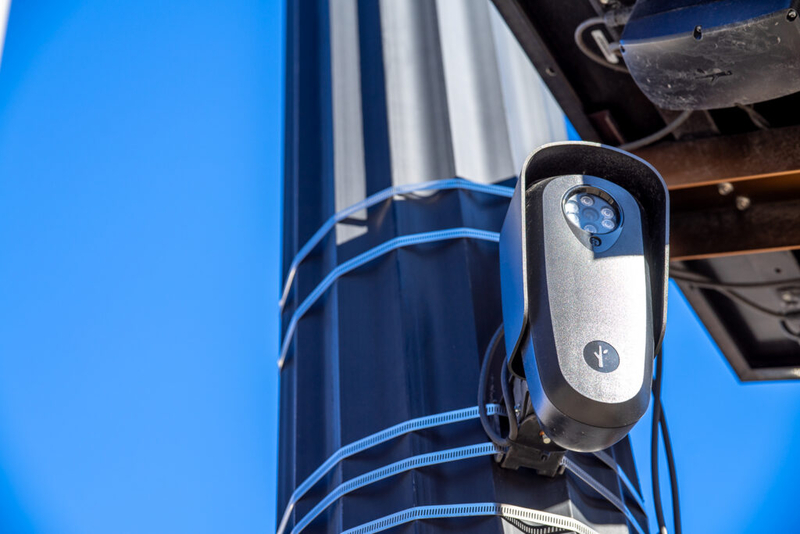
A Flock automated license plate reader records data on Point Street in Providence on Nov. 19, 2026. (Photo by Christopher Shea/Rhode Island Current)
The American Civil Liberties Union of Rhode Island is calling for significant changes to the state’s recently proposed rules for automated license plate reader cameras, arguing they leave too much latitude for police to collect, retain and access data on motorists.
In an eight-page analysis sent to Rhode Island State Police Superintendent Col. Darnell Weaver, the ACLU found the guidelines unveiled by Gov. Dan McKee in mid-October are too broadly written, offer inadequate safeguards against misuse and leave significant gaps in protecting motorists’ privacy.
“Given the significant capabilities of these systems, the policy’s shortcomings warrant careful attention and modification before serving as a model for legislation or ordinance,” wrote Madalyn McGunagle, a policy associate for the ACLU of Rhode Island.
The ACLU sent letters to Weaver, McKee, Gov.-elect Helena Buonanno Foulkes, Providence Police Chief Col. Oscar Perez, the Rhode Island Police Chiefs Association, the League of Cities and Towns, and the Rhode Island Police Accreditation Commission.
McKee ordered a statewide pause on new automated license plate reader installations in August, giving state police 60 days to review how the technology was being used and recommend standards for its use amid growing resistance to Flock Safety cameras.
The review was conducted in consultation with the Rhode Island Police Chiefs Association, the Rhode Island Police Accreditation Commission and the League of Cities and Towns. Privacy advocates, including the ACLU, criticized the process for excluding them from those discussions.
State Police ultimately produced a model policy McKee unveiled Oct. 19, offering local departments voluntary guidelines for using the technology. McKee extended the installation pause indefinitely and left it to the General Assembly to establish binding statewide rules.
McKee’s office did not immediately respond to a request for comment on the ACLU’s letter.
Jon Carvalho, a spokesperson for Foulkes’ transition team, said the governor-elect supports keeping the statewide pause on Flock cameras and other automated license plate readers in place until questions about security, privacy and transparency are addressed.
“Once all of those are clear, the state can determine if and how to move forward with any related technology for law enforcement agencies,” Carvalho said in an emailed statement to Rhode Island Current Thursday.
The League of Cities and Towns confirmed receipt of the analysis and said it planned to review the ACLU’s recommendations. Christine Crocker, executive director for the Rhode Island Police Accreditation Commission, wrote in an email to Rhode Island Current Thursday that she received the ACLU’s letter but has not yet reviewed it.
Sid Wordell, executive director of the Rhode Island Police Chiefs Association, said the group stands by the policy and disagrees with many of the ACLU’s recommendations, arguing the guidelines already address most of the concerns raised.
“We stand by what has been presented,” Wordell said in an interview.
Under the state’s model policy, police can use the cameras and access the data only for specified law enforcement purposes. Searches for federal immigration enforcement, traffic violations, outstanding fines and civil infractions, or conduct that is not a crime under Rhode Island law are also prohibited.
The policy further bars uses that violate First Amendment rights, discriminate against protected groups or interfere with reproductive rights.
Police can search the database as part of a criminal investigation when there is reasonable suspicion that a state or federal crime has been committed. The policy requires departments to delete collected data after 30 days unless it is preserved as part of an investigation.
But the ACLU warns the policy gives police too much discretion over how the cameras are used and the data accessed.
Among the organization’s central concerns is the policy’s broad definition of a “valid law enforcement purpose,” which includes open-ended goals such as crime prevention and public safety.
“This essentially allows the ALPR system to proactively track just about any individual or groups of individuals with the most meager of rationales for virtually any suspected criminal offense, as police can almost always justify access to the system based on such open-ended standards,” McGunagle wrote.
Wordell said the association recognizes the definition may need some clarification but considers a range of investigations — including hit-and-run crashes and property damage — legitimate law enforcement purposes, even when they may not involve a crime.
The ACLU also questioned why the policy allows data to be retained for 30 days, noting that Flock Safety recently revised its default retention period to seven days. Flock made the change on Aug. 13.
Wordell defended the retention period, saying investigations can take time to surface and even longer access to the data can help police solve cases.
“There’s often times that cases are not learned about a day, two days or three days in,” he said.
The ACLU called for tighter restrictions on data sharing between police departments, stronger auditing requirements and more explicit protections against using the cameras to monitor constitutionally protected activity. The ACLU also raised concerns about Flock-recorded images of people possibly being used for possible facial recognition purposes.
“While these suggested revisions are admittedly extensive, we believe they are essential if the policy’s goal is to ensure that use of this surveillance technology appropriately balances safety interests and the privacy rights of this state’s residents,” McGunagle wrote.
Providence, RI