Anti-abortion center listed on federal website accused of missing ectopic pregnancy
Nov 19, 2026 | 7:22 pm ET
Description
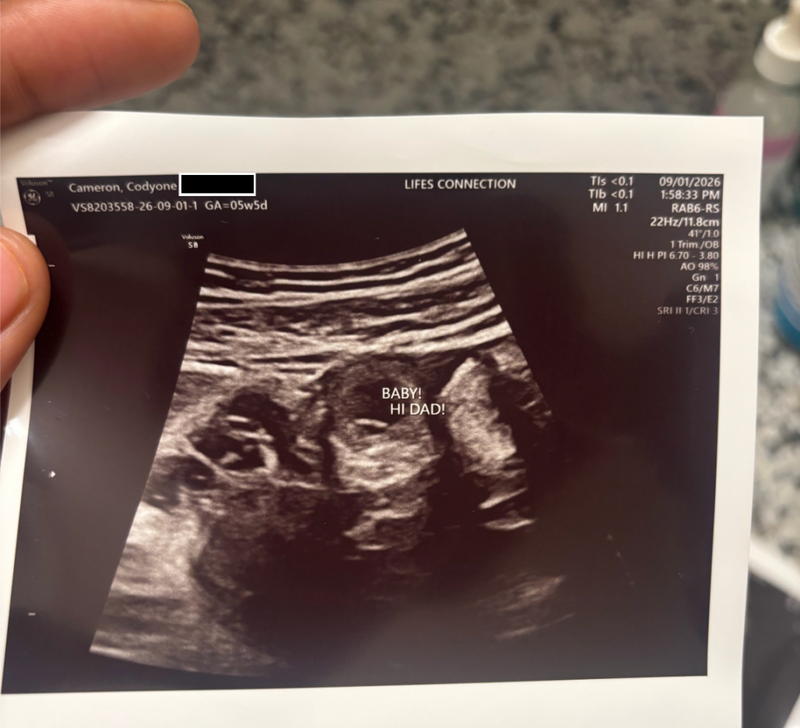
Codyone Cameron, a 32-year-old Wisconsin resident, holds the ultrasound from her visit to a crisis pregnancy center called Life’s Connection. A doctor at another clinic she visited later told Cameron that the ultrasound was not of her uterus, but her intestines, and the area marked as a baby was likely stool. (Photo courtesy of Center for Reproductive Rights)
A Wisconsin woman is asking the state attorney general’s office to investigate anti-abortion crisis pregnancy centers after she says one of them failed to diagnose an ectopic pregnancy that caused her to need emergency surgery and resulted in the loss of her fertility.
Codyone Cameron, a 32-year-old Milwaukee resident, worked with the progressive legal advocacy group Center for Reproductive Rights to send a letter to Wisconsin Attorney General Josh Kaul, a Democrat, asking for a formal investigation into whether pregnancy centers are engaging in deceptive trade and fundraising practices and the unlicensed practice of medicine.
Riley Vetterkind, a spokesperson for Kaul, said the office does not confirm or deny the existence of investigations except in rare cases of public safety.
Crisis pregnancy centers fight for ultrasound use in clinics without government oversight
Crisis pregnancy centers are organizations that typically advertise free pregnancy tests and ultrasounds, with an overarching goal of preventing and dissuading women from seeking an abortion. Many of them are affiliated with national anti-abortion organizations, including Heartbeat International, Care Net, and National Institute of Family and Life Advocates, and receiving funding from other national religious groups. States Newsroom published an investigative series earlier this year showing that 21 states directed more than $491 million in state funds to crisis pregnancy centers between fiscal years 2022 and 2025, with little oversight or accountability for how it is spent.
Wisconsin lawmakers enacted a bill in 2025 appropriating $69,100 in fiscal years 2026 and 2027 for grants for pregnancy counseling programs, which was listed by the Lozier Institute as a program for crisis pregnancy centers. Lozier is a division of Susan B. Anthony Pro-Life America, a national anti-abortion organization that partners with one of the largest crisis pregnancy center networks, Care Net. It’s unclear whether those dollars have been sent to the anti-abortion centers this fiscal year.
Crisis pregnancy centers have also been promoted by the federal government. Earlier this year, the U.S. Department of Health and Human Services launched a website called moms.gov that directs people to the anti-abortion centers in their area, as well as to federally qualified health centers. The center that Cameron visited, Life’s Connection, is listed on that website.
The centers exist in an unregulated gray area by advertising “limited” ultrasounds, and some clinics make sure to say those ultrasounds are non-diagnostic. Life’s Connection’s website says, “Schedule an ultrasound to be sure you have a viable pregnancy.”
When reached by phone on Thursday, a staff member at Life’s Connection told Stateline they do not speak to the media and did not want to respond to any of the allegations made by Cameron.
Continued pain, then surgery
Cameron had a history of ectopic pregnancy, said Alice Wang, senior staff attorney for the Center for Reproductive Rights, a legal advocacy organization based in Washington, D.C. Cameron has two children, and her third pregnancy was ectopic, which occurs when an embryo implants in a location other than the uterus, most often in the fallopian tube. Such pregnancies are never viable and can become life-threatening if untreated.
Because of that history, Cameron said, she felt the same type of pain in August after learning she was pregnant and was concerned it was also ectopic. She called an OB-GYN clinic but couldn’t get an appointment for a few weeks, Wang said, and wanted to be seen sooner. A health provider listed in a directory under the state’s Medicaid program told Cameron to call Life’s Connection, where she got an appointment.
The provider told her, I’m so sorry, these are not photos of your uterus.
In the letter to the attorney general, Cameron said she told a Life’s Connection worker dressed in medical scrubs that she was concerned her pregnancy was ectopic. The staffer, the letter said, performed an ultrasound and reassured her that the baby was inside her uterus, identifying a “yolk sac” and providing measurements with a due date.
Feeling reassured, Cameron disregarded the symptoms, and more than a week later, the pain had increased to a point she could no longer ignore it, according to the letter. She went to a community clinic that provides comprehensive reproductive healthcare, Care for All, where a doctor said the picture of her ultrasound appeared to be part of Cameron’s intestines, and that the staffer at the crisis pregnancy center had identified stool inside of her intestines as a baby.
“The provider told her, I’m so sorry, these are not photos of your uterus,” Wang said.
After further testing, the doctor at Care for All told her the pregnancy was likely ectopic and she needed to go straight to the emergency room. There, she was told she needed immediate surgery to remove both of the fallopian tubes because of the ectopic pregnancy’s advanced stage and further risks.
“Ms. Cameron can no longer achieve pregnancy without the aid of in vitro fertilization — an expensive procedure that has no guarantee of success, is not covered by Medicaid, and which she cannot afford to pay out of pocket,” the letter said.
Quick appointments, free services draw people in
Cameron’s case is not the first ectopic pregnancy missed by a crisis pregnancy center. A woman in Texas reported a similar experience in 2025 with a center that assured her the pregnancy was in the right place and normal, according to news reports, and a Massachusetts woman sued a clinic in 2022 for misleading her about her ectopic pregnancy, which ruptured and caused serious internal bleeding, requiring emergency surgery.
Taxpayer dollars flood pregnancy centers. Oversight hasn’t followed.
Dr. Anwar Jackson, a Milwaukee-based OB-GYN, said he often sees patients who went to a crisis pregnancy center before coming to see him. Wisconsin, like many other states nationwide, has a shortage of OB-GYN providers, and he said at his particular clinic, it can take up to two months to get an appointment, even for a pregnant patient. The quick availability of appointments at the crisis pregnancy centers plus the promise of free care is what draws people in, he said.
“A lot of times people will try to figure out where they can go for cheap, and CPCs take advantage of that by offering free services,” Jackson said. “In the end, it doesn’t change much, because they still have to go back into the healthcare system, a lot of times through the emergency room, which can be even more expensive.”
Jackson said someone with basic levels of ultrasound training should know whether they are looking at the intestines or a uterus.
Dr. Kristin Lyerly, a Wisconsin-based OB-GYN, said she had a similar story of a patient who had the wrong part of her body scanned. When she worked at Planned Parenthood, Lyerly said a patient came in who had been to a pregnancy center and had a copy of an ultrasound of her bladder rather than her uterus.
Lyerly is also heavily involved in legislative advocacy work, and noted the legislature will have Democratic majorities in the House and Senate next year, with women leadership, and a Democratic governor who is supportive of reproductive health issues. She and others plan to push for legislative action to regulate crisis pregnancy centers in Wisconsin in the upcoming session, which is scheduled to begin in early January.
“I’m hoping that we will have a robust agenda coming out of the gate,” Lyerly said.
Stateline reporter Kelcie Moseley-Morris can be reached at [email protected].