Ohio AG joins 42 others in fighting federal sports-betting maneuver
Nov 23, 2026 | 3:55 am ET
Description
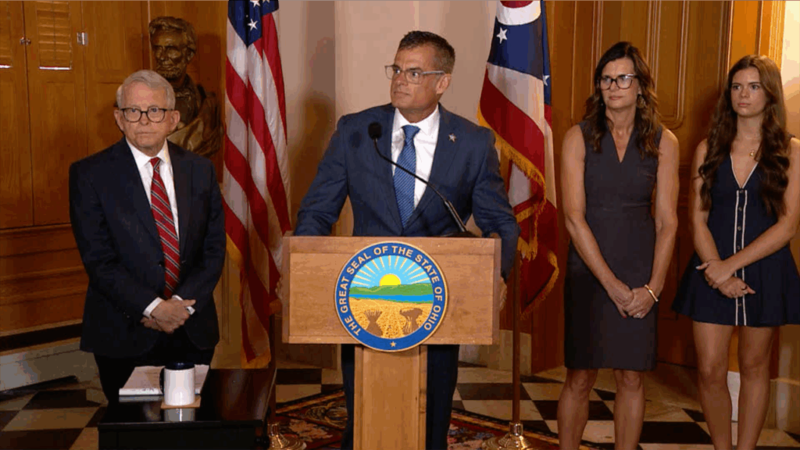
Ohio Gov. Mike DeWine, left, has chosen Public Safety Director Andy Wilson, at podium, as interim Ohio Attorney General. (Photo by Morgan Trau, WEWS.)
Ohio Attorney General Andy Wilson and a bipartisan group of 43 state attorneys general are fighting an attempt by federal regulators to “expand federal control over sports betting and undermine states’ authority to protect consumers,” according to a statement from Wilson’s office.
The Commodities Futures Trading Commission is proposing to define sports betting in prediction markets as “swaps” and take control of regulating them from the states.
Sports betting has exploded in Ohio since it became legal at the start of 2023. With $10.3 billion wagered in 2025, it now has the fourth-largest market in the United States.
Being able to gamble so conveniently has come with serious social problems.
The UCLA Anderson School of Management in 2025 reported that entire states’ average credit scores took a hit when sports betting was legalized in them. That’s not just the average credit scores of gamblers, but of everybody in the state.
A separate study linked legalized gambling to increased crime — including violent crime.
Amid accusations that big-time athletes are rigging at least parts of games, Ohio Gov. Mike DeWine a year ago told the Associated Press that he regrets signing Ohio’s sports betting law.
And those are problems associated with state-regulated and taxed sports-betting companies such as DraftKings. Wilson and his counterparts worry that the federal move will allow prediction markets such as Kalshi to offer sports betting without giving states much of a say.
A letter from the attorneys general to the Commodities Futures Trading Commission “warns that the proposal could encourage traditional sportsbooks to reorganize as prediction markets, effectively sidestepping state gambling laws and leaving consumers without established safeguards,” a written statement from the Ohio Attorney General’s office says.
It added, “Prediction markets allow users to wager on sporting events much like traditional sportsbooks, but without the same state oversight. The proposed rule could further open the door for these platforms to bypass licensing requirements, age restrictions and protections against problem gambling.”
In the statement, Wilson accused the commission of trying to override Congress and the courts.
“A sports bet isn’t a derivative just because the CFTC says so,” he said. “The agency doesn’t get to invent powers that Congress never gave it, ignore federal court decisions and bulldoze state consumer protections. If Congress wanted the commission running sports gambling, it would have said so — and headquartered it in Las Vegas.”
Wilson joined attorneys general from Kentucky, Maryland, Nevada, New Jersey, New York, Tennessee and Utah in leading the coalition.
Columbus, OH