Pa. AG Dave Sunday launches effort to prevent cryptocurrency scams at Bitcoin ATMs
Oct 30, 2026 | 3:54 am ET
Description
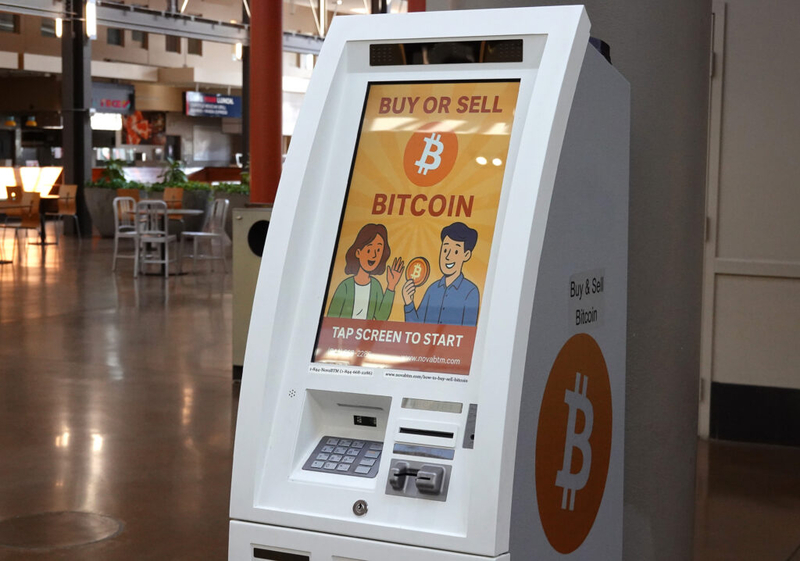
A view of a Bitcoin ATM at Northgate Mall on February 05, 2026 in San Rafael, California. (Photo by Justin Sullivan/Getty Images)
Tens of thousands of Pennsylvanians lost millions to cryptocurrency scams last year. To help halt the flow of stolen funds, state Attorney General Dave Sunday is urging business owners with cryptocurrency kiosks to voluntarily place signage warning about popular tactics used to trick victims, especially the elderly.
Cryptocurrency may be an increasingly popular option for investments and banking, “but for many Pennsylvanians, particularly older adults unfamiliar with this technology, it can be very confusing,” Sunday said Thursday, speaking at a Monroe County senior center.
“(Scammers) exploit the unfamiliarity through fraudulent investment opportunities, online romance scams and cryptocurrency kiosks, commonly known as Bitcoin ATMs,” continued Sunday. “These are calculated attempts to frighten, manipulate and deceive people into handing over their money with devastating consequences.”
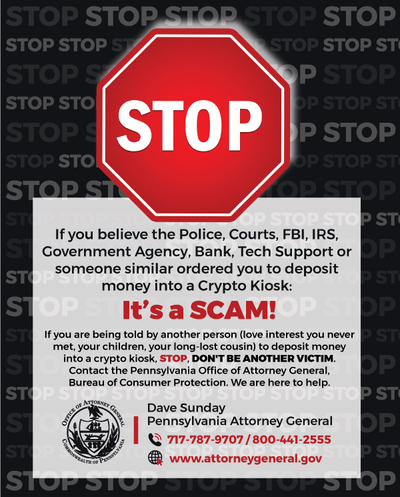
The signs urge people to “stop and verify” if someone pressures them to send money through the machines, and to report suspected scams to the agency’s Bureau of Consumer Protection at 1-800-441-2555.
“Stop before making a financial decisions because someone is threatening you or someone you love is promising you an opportunity that sounds too good to be true,” Sunday continued. “These signs are designed to reach people in that critical moment when they are standing in front of one of these machines, and they may be seconds away from putting their life savings into a transaction that they may never be able to reverse.”
It’s not clear how many cryptocurrency kiosks sit in the commonwealth’s gas stations, grocery stores or other retail locations, but one vendor reported upwards of 450 operating ATMs earlier this year. The machines convert cash into digital currency, which can be stored in a digital wallet.
Lawmakers considered a proposal to regulate the kiosks earlier this year, requiring anti-fraud warnings and enhanced safeguards, but Senate Bill 1015 ultimately didn’t advance out of committee.
An ever-growing problem
Funds, once transferred to another person, are difficult to recover.
Americans lost nearly $21 billion in cryptocurrency and artificial intelligence scams last year, according to the FBI, including $538 million in Pennsylvania.
Sunday specifically warned about people who impersonate law enforcement or other government employees to pressure victims into turning over their assets.
“They may claim you have an outstanding warrant, that you missed jury duty or that you owe money for a violation. Then comes the threat: pay immediately, or you will be arrested,” said Sunday. “Let me be absolutely clear: no legitimate law enforcement agency or court will direct you to a cryptocurrency kiosk to pay a fine, resolve a warrant or avoid arrest.”
Pa. senators weigh consumer protections from cryptocurrency scams
If someone makes that demand, he advised Pennsylvanians to hang up and call the agency independently.
Other scammers may use romance or build trust over months before trying to collect money, he added.
He noted that his office was working with the Pennsylvania Food Merchants Association to provide training and distribute flyers to their members, which includes convenience stores, supermarkets, grocers and more.
“Cryptocurrency is the latest front in the longstanding battle against consumer fraud,” said PFMA president and CEO in an agency press release. “PFMA remains committed to protecting our members from fraud and the public, our members’ customers, from abuse. We value our partnership with OAG and law enforcement across Pennsylvania to raise awareness about crypto fraud schemes and equip the retail community to fight back against this novel threat.”
Sunday reported 290 scam complaints involving cryptocurrency to his office last year, likely an undercount since many victims don’t report the crime to authorities.
“Some (victims) are embarrassed, others believe nothing can be done and some do not realize that they even were targeted until it’s too late,” Sunday added. “Scammers rely on fear, secrecy and urgency. They want their victims to believe they have no choice, that no one can help them and that they must act immediately. Our goal with this effort is to break that cycle.”

Harrisburg, PA