With small margins, democratic socialists could have outsized influence in Georgia state House
Nov 19, 2026 | 4:00 am ET
Description
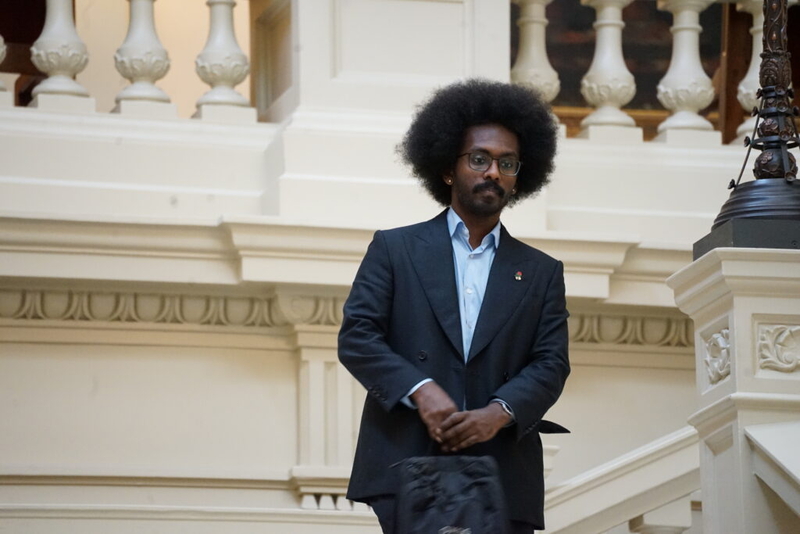
Georgia House Representative-elect Mathewos Samson, who identifies as a democratic socialist, is pictured at the state Capitol on Nov. 12, 2026. Alander Rocha/Georgia Recorder
For the first time in two decades, Georgia Democrats will control the state House of Representatives when the General Assembly convenes in January.
But Democrats will have a razor-thin majority. Not only will they have to work and compromise with Senate Republicans to get their legislative priorities to the governor’s desk, but they will also have to keep their House Democratic caucus united enough to pass bills in their own chamber.
A small but growing contingent of Democratic Socialists of America members may complicate those efforts as they try to push House Democrats further to the left. Democratic state Rep. Gabriel Sanchez, a lawmaker who identifies as a democratic socialist, was just reelected to a second term representing a Smyrna-area House district. Democratic state Representative-elect Mathewos Samson, who also identifies as a democratic socialist, just won an open seat representing Atlanta.
In a chamber where nearly every Democrat will be needed to pass the caucus’ legislative priorities, Sanchez and Samson will have some leverage they can use to advocate for more aggressive policies on housing, healthcare and raising the minimum wage. And they both indicated that they plan to work with their party to get their priorities passed while also pushing policies further left.
“The reality is that there’s a two, maybe three-person majority, which means our democratic socialists Gabriel and Mathewos will have a lot of power on whether things can or cannot be passed,” said Bryan Ramirez, the co-chair of Democratic Socialist of America’s Atlanta chapter. “So, the (House Democratic) caucus is required to work with our DSA members, and that allows us to push any type of legislation further left if we can.”
Democrats needed to win 91 seats to take control of the state House, and that is currently the exact number they hold. Three House races are still unresolved, with one going to a Dec. 1 runoff and two still too close to call – although a hand count just confirmed the lead of a GOP incumbent. Aside from two DSA-endorsed members, there will be 17 House Democrats – 18 if they win the December runoff – who were endorsed by the progressive Working Families Party.
But House Democratic leadership seemed confident that an economic agenda focused on addressing affordability will lessen any ideological friction across the caucus.
“Regardless of titles or labels, there is a lot of common ground and a lot of shared interest, along with a lot of shared understanding of how we need to deliver over these next two years,” said Lawrenceville Democratic state Rep. Sam Park, who was previously minority whip and will now serve as majority whip in the new session.
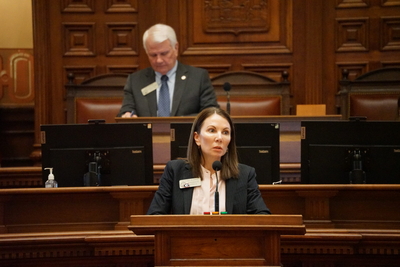
State Rep. Stacey Evans, an Atlanta Democrat who will serve as majority leader, echoed Park, saying that Democrats are united in addressing kitchen table issues.
“We are a big tent party, and whatever part of the spectrum you find yourself on – affordability, healthcare access, education – we all share those priorities,” Evans said. “I see us working on priorities that everyone can get behind, and I think that’ll go a long way toward making everyone feel like they’re contributing, that their voice matters and that their constituents are heard.”
Still, there are stark policy gaps between Democrats and its democratic socialist faction. While there appears to be Democratic unity on issues like Medicaid expansion, repealing the state’s six-week abortion ban and raising the minimum wage to $15 per hour, the Democratic Socialists of America wants to go beyond that.
“Let’s focus on that,” Ramirez said, pointing to House Democrats’ priorities. “But also let’s ensure that it’s not just $15 an hour. Let’s try to get $20 an hour. Let’s not just repeal the (abortion) ban, but provide easy and accessible access to abortion care and trans healthcare to everybody.”
Samson also said that he “definitely plan(s) to work with the new Democratic majority” and is behind longstanding Democratic priorities, but he said he also believes that lawmakers shouldn’t stop there.
“We have to end the abortion ban and also actually codify abortion as a right in Georgia. We have to expand Medicaid, but we should also strive to pass Medicare for all in Georgia,” Samson said.
While Medicare is purely a federal program, Sanchez earlier this year introduced a bill titled “Georgia Medicare for All Act,” which would have created a universal single-payer healthcare program covering all Georgians without any out-of-pocket costs. The bill did not move after it was introduced in the 2026 legislative session.
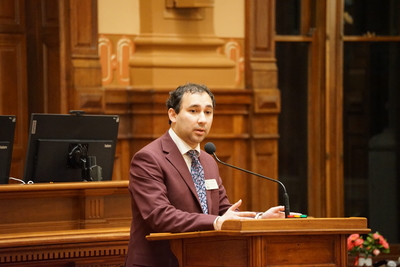
Sanchez, who easily secured a second term in November, said he intends to work and cooperate with the incoming Democratic majority while advocating for more progressive policies.
“We just elected a new speaker nominee. It was unanimous. We’re ready to fight and work with the Democrats to fight for Georgians. We’re going to do everything in our power to work where we agree, and then if disagreements come about, we’ll have those conversations and see where we go,” he said.
Sanchez said that he sees much of the Democratic agenda on affordability as a result of democratic socialism policies rising in popularity nationally.
“Who started that? It was Zohran Mamdani and the DSA. We are pushing our party into a direction that’s actually going to center working people and not just those at the top. We’re going to continue to do that because, again, we all agree that we want to help Georgians,” Sanchez added.
Sanchez’s incoming colleague Samson agrees and says democratic socialist policy proposals are gaining popularity with voters despite previous opposition.
Samson said that’s because democratic socialists can be more outspoken about challenges affecting workers since they act independently from corporate donors. The incoming freshman lawmaker said that Americans are listening to their economic messaging and are realizing that “the things we’re advocating for are not actually that radical.”
A number of Republicans on the 2026 campaign trail tried to tie their opponents to democratic socialism, with Congressman Mike Collins saying in his failed run for Senate that Sen. Jon Ossoff wants to “run as the DSA presidential candidate.” But their efforts seemed to flop. Two more major U.S. cities, Los Angeles and Washington D.C., elected democratic socialist mayors, and the faction quadrupled their numbers in the U.S. House of Representatives, and in some cases unseated more moderate Democrats.
“We have a moral clarity,” Samson said, pointing to democratic socialists’ view that some policies and actions by the government largely prioritizes profits over people, pointing to the war in Iran as an example.
“It’s extremely unpopular. It’s extremely undemocratic,” Samson said.
Even if progressives are successful in pushing legislation further to the left in the House, any legislation must still pass the state Senate, where Republicans hold a slim majority. Democratic leaders will have to thread a needle as they try to appease the left wing of their party while drafting legislation that can survive and move through Senate committees, says Tammy Greer, a political scientist at Georgia State University.
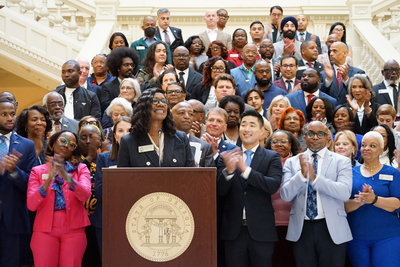
Although House Democratic leaders will have to work differently with more progressive members of their party than with Senate Republicans, “the skill set is the same for the Democrats,” Greer said.
“The Republicans and DSA may have different reasons and directions for their opposition,” Greer said. “Yet the communication skills and the compromise, or the ability to negotiate, is the muscle that Democrats are going to really flex or learn or enhance this legislative session, this one and the next one, to get anything passed for the governor’s agenda.”
Greer also said that with a fast-paced, 40-day legislative session, it leaves little room for intraparty disagreements.
“They don’t need to spend those 40 days fussing with each other,” she said. “And so, are they prepared to lead, to start January reading from the same book, same chapter, same page, same line? And if they’re not, then that’s going to hamper any progress.”
Atlanta, GA