State Supreme court deems turn-signal stop ‘unreasonable’ in DUI case
Jun 11, 2026 | 5:15 pm ET
Description
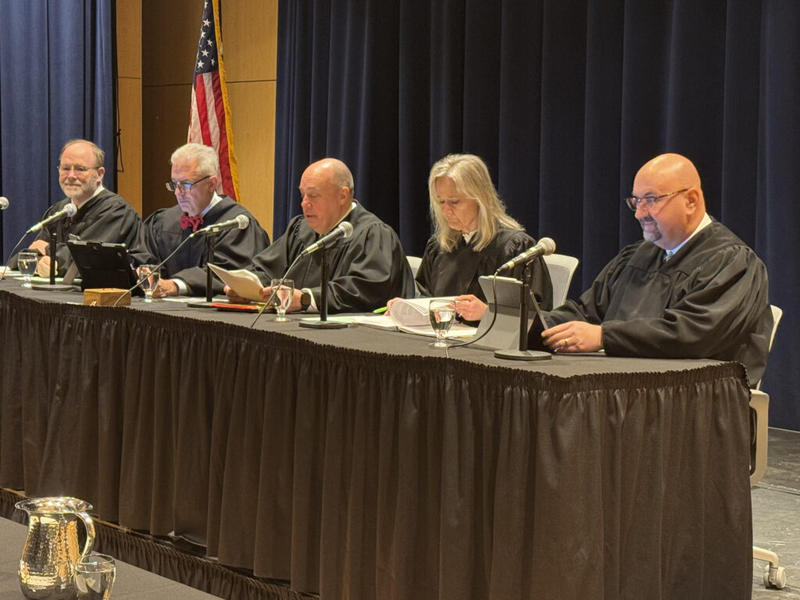
South Dakota Supreme Court justices hear cases on March 18, 2026, in Sioux Falls. From left are Scott Myren, Mark Salter, Chief Justice Steven Jensen, Patricia Devaney and Robert Gusinsky. (Pool photo by Bart Pfankuch/South Dakota News Watch)
The South Dakota Supreme Court has overturned a drunken driving conviction that was predicated on a driver’s failure to use his turn signal 100 feet before reaching a stop sign.
In a 5-0 decision, the high court ruled that the Aberdeen police officer’s decision to initiate the stop was “objectively unreasonable” and based on an “incomplete” understanding of the law.
State law does not require the use of a turn signal in all circumstances, the court pointed out.
Instead, it requires that a driver must use a “plainly visible” signal “whenever the operation of any other vehicle may be affected” by a turn.
The driver did use his right turn signal in the Aberdeen case, but only after he’d come to a complete stop at a stop sign. The officer was about a block behind him, pulled him over for failing to signal sooner and arrested him for driving under the influence.
The officer was relying on a separate South Dakota law that says, “when required,” a turn signal must be used by a driver at least 100 feet before making a turn.
The driver, however, cited the law noting that signals are only required when a turn might affect another vehicle. He claimed the officer had no valid reason to make the traffic stop, because there were no people or other vehicles around. A judge rejected that argument during a court trial, where the driver was convicted of DUI.
The high court sided with the driver. There was no evidence the driver was traveling “in a residential area with pedestrians or multiple vehicles nearby,” the opinion says. The officer’s vehicle, a block behind the driver, it says, couldn’t have been affected by the driver’s right-hand turn.
The officer testified at the trial court level that he was unfamiliar with state law on when turn signals are required, so the justices wrote that his decision to pull the driver over was “objectively unreasonable.”
“There was no reasonable suspicion justifying the stop,” the court ruled.
Stand your ground law
The court released two other decisions on Thursday clarifying the state’s “stand your ground” laws, which entitle citizens facing assault or homicide charges to a pretrial immunity hearing. Those who fail to have a case tossed out before trial remain free to make self-defense claims to a jury.
The two newly decided cases involved men who’d failed to earn immunity at their pretrial self-defense hearings, and were later convicted by juries in spite of their ongoing self-defense claims.
Both men claimed that errors had occurred during their immunity hearings. One had already tried unsuccessfully to secure a second pretrial immunity hearing in an appeal to the state Supreme Court that was filed between his initial failure to earn immunity and his jury trial. He raised similar arguments in the post-conviction appeal rejected by Thursday’s ruling.
The justices reached similar decisions in both of the cases decided on Thursday, saying in each opinion that a jury’s rejection of self-defense claims renders any dispute over pretrial immunity hearings moot.
Attorney General Marty Jackley issued a news release praising the decisions as valuable in clarifying the application of the state’s self-defense laws.
“By confirming that immunity challenges can only be raised before trial, the court has given prosecutors, defense counsel, and circuit courts a clear procedural framework moving forward,” Jackley said.

Pierre, SD