
West Virginia’s unfinished work: Finishing the economic dreams of Dr. Leon Sullivan, Walter Reuther
Nov 26, 2026 | 5:55 am ET
Description
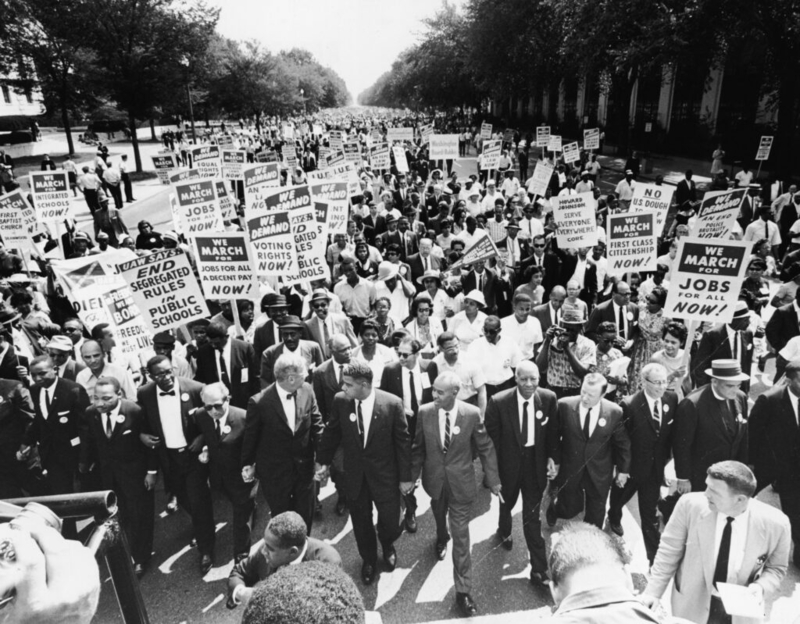
Civil rights Leaders hold hands as they lead a crowd of hundreds of thousands at the March on Washington for Jobs and Freedom in Washington D.C., on Aug. 28, 1963. Those in attendance include (front row, left to right): James Meredith and Martin Luther King, Jr., Roy Wilkins light-colored suit), A. Phillip Randolph and Walther Reuther. (Photo by Express/Hulton Archive/Getty Images)
Dr. Leon Sullivan and Walter Reuther are two West Virginians worth knowing about. In the 1960’s and ’70s they blazed a path towards racial and labor justice — and now, we are losing the way.
Here are the facts: Dr. Leon Sullivan was Black and Walter Reuther was white. Reuther grew up in Wheeling; Sullivan in Charleston. They were named West Virginian of the Year back-to-back. Sullivan in 1965; Reuther in 1966.
Sullivan became the first Black man appointed to the board of a top-tier U.S. corporation: General Motors in 1971. Sullivan decided that by joining he could, in the “short run and long run make things better for my people,” the New York Times reported in 1971.
He went on to be the architect of the Sullivan Principles and recipient of the Presidential Medal of Freedom.
The Sullivan Principles were business guidelines for companies to support human rights in apartheid South Africa. Some of the original principles included nondiscrimination, equal pay, integration and community development.
And Walter Reuther’s activism has overlapping racial and economic goals. And the two both catalyzed change through cars.
Reuther served as president of the United Auto Workers from 1946 until 1970 and marched alongside Dr. King in Selma, Alabama. He and his brother survived assasination attempts and risked their lives to fight for unions.
So what’s the status of unions now? Rocky. Between 1985 and 2025, West Virginia experienced the largest percentage-point drop in private-sector union membership of any U.S. state, writes the Center for Economic and Policy Research. It fell 16.7 percentage points from 22.2% to 5.5% in 2025. It’s staggering.
According to the Bureau of Labor Statistics, across America, union membership fell from 20.1% in 1983 to 10% in 2025. Since then, there has been greater income inequality, lower bargaining power for workers and lost rights.
For the last 30 years, intense corporate opposition and threats, jobs shipped overseas and a dwindling manufacturing sector have contributed to the decline.
So what would Reuther and Sullivan have to say about it? First they’d have a little talk with Gov. Patrick Morrisey. They’d scrutinize his lofty job promises connected to data centers and AI computing, new natural gas power plants and defense technology.
They’d want to know: How many union jobs? What are the healthcare benefits? What percentage of jobs are guaranteed for West Virginians? Retirement security?
Equal access for women and people of color?
It absolutely matters. Because in these times, such concepts are far from guaranteed. The Trump administration is clawing back worker protections.
For example, the Trump administration ended affirmative action requirements for federal contractors that involved years of fighting for change. It revoked Executive Order 11246. This policy dated back to 1965 and was a requirement to promote equal opportunity for workers of color and women.
Trump also directed the Department of Labor to stop enforcing those workplace protection requirements and reporting. And companies are now no longer required to report racial and gender demographics, such as who is most represented in management positions.
Third, the Trump administration is taking active steps to undermine the Equal Employment Opportunity Commission. This weakens tools to address workplace discrimination.
And, though attacked, the Civil Rights Act of 1964 still remains, as well as the equal pay act. Thank goodness. But let’s keep our eye on the ball to ensure it stays that way. Nothing is sacred anymore.
Because here’s the deal: West Virginia’s poverty proves that financial success is not always measured by the almighty dollar. It is measured by safe conditions, worker protections and if people of all types have access to opportunities in the workplace.
Sullivan and Reuther knew racial justice and economics are inextricably intertwined
and that both matter for America’s future.
The pair lead us far in union organizing and racial harmony, but who will take the baton?
The economic center cannot hold. And when conditions get bad — rock bottom — people finally rise up. We’ve had enough. The ghosts of Sullivan and Reuther are waiting.

Charleston, WV